
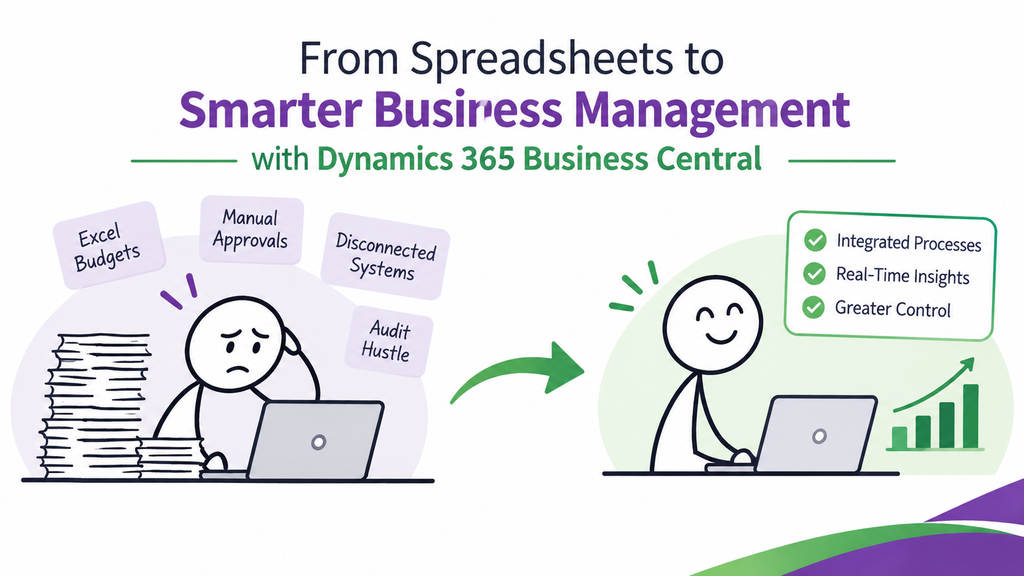
How modern ERP systems like Microsoft Dynamics 365 Business Central help businesses move beyond outdated ways of working.
Imagine Company X. It is a growing business. It has employees, customers, suppliers, a fleet of vehicles, several departments and an increasingly busy finance team.
Sales are coming in. Orders are being processed. New employees are joining. Management is exploring opportunities for expansion.
From the outside, things seem to be going well.
But behind the scenes, running the business is becoming a different story.
The finance team still manages departmental budgets in Excel spreadsheets, often maintaining several versions of the same document. When management needs to know how much a department has spent against its allocation, someone has to collect the latest figures, reconcile them and confirm that everyone is working with the same information.
The operations team manages a fleet of vehicles, but tracking fuel consumption, maintenance costs, vehicle assignments and related expenses is largely manual. By the time management gets a complete picture of fleet expenditure, some of the information may already be outdated.
Petty cash requests move from one desk to another for approval. Supporting documents are exchanged through emails or carried physically. Following up on a request can take longer than processing it.
Human Resources has its own system for managing employee information, leave and payroll. Finance, however, operates separately. When salary information, employee changes or payroll figures need to be reflected in the accounts, there is often a need for manual intervention.
And then there is reporting.
Every month, management requests financial and operational reports. The finance team spends considerable time collecting information from different departments, checking figures against spreadsheets, following up with employees and validating records from multiple sources.
By the time the report is ready, some of the information may no longer reflect the current position of the business.
Audits are another challenge. Finding supporting documents, tracing transactions, establishing who approved what and confirming whether the right procedures were followed becomes an exercise in searching through emails, folders, spreadsheets and physical records.
Even introducing a small improvement to an existing process can be difficult. The business depends on systems that are poorly integrated, difficult to modify or no longer adequately supported. New requirements are met with workarounds rather than sustainable improvements.
This company is not necessarily struggling because it lacks capable employees or because people are not working hard enough.
It has a systems problem.
And this is a situation many growing businesses can find themselves in: the business has evolved, but the systems supporting it have not evolved at the same pace.
The cost of running a modern business on yesterday’s systems
The challenge with outdated processes is not always immediately visible.
It is easy to overlook the time spent reconciling spreadsheets, following up on approvals, re-entering information or searching for supporting documents. These activities become part of the normal working day.
But collectively, they have a cost.
Employees spend more time administering processes and less time on work that moves the business forward. Management has to make decisions using information that may be incomplete or outdated. Finance teams struggle to maintain a clear picture of expenditure, cash flow and financial performance.
As the business grows, these difficulties become even more pronounced.
Adding more employees, branches, departments, vehicles or transactions to an already fragmented environment does not necessarily make the business more efficient. In many cases, it simply increases the complexity of managing it.
This is where a modern Enterprise Resource Planning (ERP) system becomes particularly valuable.
Bringing the business together with Microsoft Dynamics 365 Business Central
Imagine Company X taking a different approach. Instead of maintaining disconnected systems and relying on manual processes to keep everything together, it introduces Microsoft Dynamics 365 Business Central.
Business Central provides an integrated business management platform that brings core financial management, purchasing, sales, inventory and other operational processes into one connected environment.
What does that change in practice?
1. Budgets become part of financial control, not just spreadsheets.
With Business Central, budgets can be created and managed within the financial system. Management can work with departmental dimensions, financial reporting and actual-versus-budget comparisons to understand how the business is performing against its financial plans.
Rather than relying entirely on separate spreadsheets to establish the financial position, decision-makers can work with information drawn from recorded transactions.
2. Financial transactions become easier to trace.
From purchase invoices and payment entries to general ledger transactions, Business Central maintains transaction records and supporting information.
With appropriate approval workflows, permissions and document management practices, businesses can establish clearer processes for reviewing and authorizing transactions.
When audit time comes, finance teams have a more structured environment in which to trace entries, review records and retrieve supporting documentation.
3. Petty cash and expenditure processes become more structured.
Businesses can configure approval workflows and payment processes to suit their internal controls.
Requests, approvals and financial postings can follow defined procedures rather than depending entirely on informal email exchanges and physical paperwork.
The result is better visibility over who is responsible for an approval and where a transaction stands in the process.
4. Finance and HR processes can work more closely together.
Through integrations and appropriate configuration, Business Central can exchange information with HR and payroll applications.
Employee-related financial transactions, payroll journals and other relevant information can be transferred into the accounting environment with less repetitive manual data entry.
Alternatively, customizations like payroll and human resource management, product offered by HRP Solutions Uganda Ltd, HR and Finance are directly speaking within the same ERP.
This is particularly useful for businesses that want to reduce duplication while maintaining appropriate controls over employee and financial information.
5. Fleet and operational expenditure can become more visible.
Vehicle management may require a dedicated fleet management solution or an extension integrated with Business Central.
However, the financial side of fleet operations can be brought into a more structured environment. Fuel purchases, maintenance invoices, vehicle-related expenses and supplier payments can be recorded and analyzed using financial dimensions and reporting tools.
This gives management a better basis for understanding the cost of running its fleet, rather than relying on disconnected expense records.
6. Reporting becomes more meaningful.
Microsoft Dynamics 365 Business Central offers financial reporting, analysis views, account schedules and integration with Microsoft Power BI.
Management can use these capabilities to examine revenue, expenditure, budgets, outstanding receivables, payables and other important business indicators.
Instead of spending most of the reporting cycle collecting and validating information, teams can devote more attention to understanding what the numbers mean and what action should follow.
7. The business gets room to improve as it grows.
One of the important considerations when choosing an ERP is not simply what it can do today, but how well it can accommodate tomorrow’s requirements.
Business Central supports extensions, integrations, customizations and regular product improvements. Businesses can extend functionality to address specific operational needs while benefiting from Microsoft’s ongoing investment in the platform.
This creates opportunities to improve processes without having to rebuild the entire business management environment every time a new requirement emerges.
It is not just about replacing spreadsheets
There is an important distinction worth making here.
Moving to an ERP is not simply about taking information out of Excel and putting it into another system.
It is about reconsidering how information flows through the business.
Who initiates a request? Who approves it? Where is the supporting documentation stored? How does a purchase affect the budget? How does a transaction reach the financial statements? How can management establish whether the business is performing as expected?
These are business questions, not merely software questions.
A successful ERP implementation should therefore begin with understanding existing processes, identifying gaps, agreeing on appropriate controls and configuring the system to support the way the business needs to operate.
Not every process needs to be automated, and not every existing system needs to be discarded. Some specialized applications may remain necessary, with integrations connecting them to the wider business environment.
The objective is to reduce unnecessary fragmentation and establish a more reliable way of managing the organization.
A business should not have to work harder just to keep track of itself
Let’s return to Company X. It still has customers to serve, suppliers to pay, employees to support, vehicles to maintain and budgets to manage.
Those responsibilities have not changed.
What changes is how much effort the business has to spend keeping everything together.
With the right ERP solution, finance has better visibility over transactions, management has more meaningful information for decision-making, operational teams can follow more structured processes and employees spend less time chasing information across disconnected systems.
That is the real value of modern business management technology.
Microsoft Dynamics 365 Business Central gives growing organizations an opportunity to move away from fragmented ways of working and build a more connected, controlled and informed business environment.
Because growth should bring new opportunities, not simply more spreadsheets, more paperwork and more administrative work.
If your organization is ready to rethink how it manages its operations, the right implementation partner can help you take that next step.
HRP Solutions Uganda Ltd , a Microsoft Solutions Partner specializing in Business Applications, helps businesses implement, customize and optimize Microsoft Dynamics 365 Business Central and other Microsoft business solutions to support their evolving needs.
Whether you are looking to improve financial management, streamline procurement, strengthen reporting or connect previously disconnected business processes, our team can help you explore a solution that works for your organization.
Learn more about how HRP Solutions can support your business at https://hrpsolutions.com/
This article was originally published on the HRP Solutions LinkedIn Page.